Dimensions of Olympic Pool: Standard 50m x 25m
Explore the dimensions of Olympic pool design: 50 m length, 25 m width, and depth guidelines that ensure fairness and performance. What Dimensions explains the core metrics and verification practices.


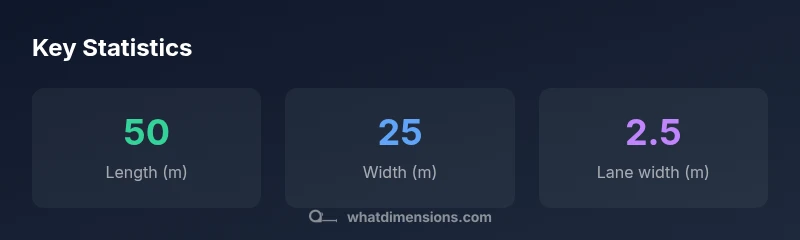
The dimensions of olympic pool are defined by a 50-meter length, a 25-meter width, and depth guidelines that minimize wave action to ensure fair competition. Lanes are typically 2.5 meters wide, with 8–10 lanes used depending on the venue. Depth is usually uniform, helping to reduce turbulence and ensure consistent racing conditions.
What defines an Olympic pool
According to What Dimensions, the core definition of an Olympic pool centers on a standardized competition environment designed to minimize extraneous variables that could affect performance. The official competition length is 50 meters, and the pool width aligns with a 25-meter deck-to-deck footprint that accommodates a typical 8- to 10-lane arrangement. The design also considers depth uniformity to reduce turbulence and ensure consistent racing conditions across all lanes. These dimensions are intended to maintain fairness, enable precise timing, and allow international records to be meaningfully compared across venues. In practice, venues must meet these metrics while also addressing site constraints, safety standards, and local building codes. In short, the dimensions of olympic pool are chosen to standardize competition while balancing architectural feasibility.
What Dimensions emphasizes that the exact construction tolerances matter just as much as the nominal numbers, because even small deviations can influence wave patterns and turn dynamics.
Exact vs. implied dimensions
The Olympic standard specifies clear nominal measurements (50 m length, 25 m width, lane widths, and depth range). However, real-world constructions include allowable tolerances to account for manufacturing imperfections and measurement inaccuracies. For example, a pool might be built to ±1 centimeter in length and width, with depth tolerances within a few centimeters. These margins are essential for practical fabrication and safety compliance, yet they must be controlled tightly to avoid affecting race fairness. Designers and operators use calibrated surveys, end-marker alignment, and depth checks at multiple points to verify that the finished facility conforms to the intended dimensions. What Dimensions notes that documentation and third-party verification are critical to prevent disputes during competition.
- Keep a site survey log with timestamped measurements.
- Cross-check end-to-end length with pool deck markers before events.
The standard length and width in practice
In most Olympic venues, the competition pool measures exactly 50 meters in length and 25 meters in width, which translates to 10 lanes at 2.5 meters each. The outer lanes may be used for warm-up or cooling, depending on the venue's layout. While the core dimensions are fixed, variations can occur in the transitional areas (like start blocks and turn basins) that influence wake propagation and turning time. The fixed length ensures that world records are comparable across events and eras. What Dimensions highlights that these practical arrangements support consistent race geometry, which underpins fair competition and reliable timing.
Designers should plan for sufficient space around the pool for officials, timers, and safety zones, while ensuring that the core 50 m x 25 m envelope remains uncluttered.
Depth and its role in performance
Depth is a critical factor in reducing wave action and ensuring stable buoyancy conditions for swimmers. The typical minimum depth for an Olympic pool is around 2.0 meters, with many venues opting for deeper sections (up to 3.0 meters or more) where feasible. Deeper pools tend to generate more uniform wave dissipation, particularly during starts and turns, which can influence seed times and final results. Uniform depth is also important for fair lane comparisons, as varying depths can alter hydrodynamic resistance. What Dimensions explains that designers often include deeper shoulders or uniform depths throughout the pool to minimize turbulence and provide a predictable racing environment.
Measurement and verification processes
Verification of Olympic pool dimensions involves multi-point measurements along the pool length, width, and depth. Officials use calibrated measuring tapes, laser rangefinders, and water level checks to confirm that the marks at each end align with the 50 m standard. Depth is verified at several cross-sections to ensure uniformity within the allowed tolerances. Documentation should record the measurement method, tool calibration dates, and environmental conditions during verification. This rigorous process reduces the risk of disputes and supports consistent performance benchmarks across different venues.
Variations by competition level and venue
While the Olympic standard is fixed, venues may implement practical adaptations for training or regional competitions. Training pools may be configured with fewer lanes or slightly different widths, but when a facility hosts Olympic events, it must meet the official dimensions. Architects balance modularity with the need for precise fabrication: walls, lane lines, and start blocks must align to the 50 m x 25 m envelope. What Dimensions notes that even small architectural deviations can ripple into race dynamics, so rigorous pre-event checks are common in high-level venues.
Design implications for architects and suppliers
For designers and suppliers, Olympic pool dimensions dictate the choice of materials, tank geometry, and finishing details. The 50 m length requires long, straight concrete shells and precise end-wall placements to ensure straight-line accuracy. Lane lines, gutter systems, and overflow channels must be engineered to accommodate 2.5 m lanes while maintaining water quality and energy efficiency. Suppliers should provide documentation on tolerances and QA records to guarantee conformance to the standard. What Dimensions emphasizes that early-stage collaboration between architects, engineers, and governing bodies reduces the risk of mid-project redesigns.
How to verify dimensions in retrofit projects
Retrofits demand careful re-measurement to ensure that the pool remains compliant with Olympic standards if it is used for competition. Start with a fresh site survey, re-measure the pool length and width, and confirm lane width and depth uniformity. If modifications are needed, document the changes and re-check all critical dimensions. Additionally, verify deck space, marking boards, and safety clearances around the pool perimeter to maintain regulatory compliance. The What Dimensions team recommends a formal post-retrofit verification by an independent inspector.
Key specifications of Olympic pool dimensions
| Dimension | Specification | Notes |
|---|---|---|
| Length | 50 m | Official competition length |
| Width | 25 m | Pool width for competition lane area |
| Minimum depth | 2.0 m | To reduce turbulence and wave action |
Quick Answers
What are the standard Olympic pool dimensions?
Olympic competition pools follow a 50 m length and 25 m width, with 2.5 m-wide lanes. Depth is maintained to reduce turbulence. These core metrics enable fair comparison of performances across venues.
The standard Olympic pool is 50 meters long and 25 meters wide, with 2.5 meter lanes and a uniform depth to reduce turbulence.
Do all Olympic pools have the same depth?
Depth typically ranges from 2.0 to 3.0 meters, with many venues aiming for uniform depth to minimize wave effects. Local constraints may introduce minor variations, but competition pools strive for uniform depth.
Depth is generally 2 to 3 meters, with uniform depth preferred to reduce waves.
How is the length verified during competition?
Length verification uses calibrated marks and measurement tools to confirm the 50-meter span. Officials cross-check end-to-end alignment and ensure the measurement is taken under official conditions.
Officials verify the pool length with calibrated tools to confirm it’s exactly 50 meters.
Can training pools match Olympic dimensions?
Yes, many training pools replicate Olympic dimensions, but only venues meeting official standards can host Olympic events. Facilities often use the same 50 m by 25 m envelope for practice to ensure consistency.
Training pools can match the size, but only certified venues host Olympic events.
Why are lane widths standardized at 2.5 m?
A 2.5 m lane width balances geometric fairness and wave management. Standardized lanes help ensure comparable race conditions and accurate timing across venues.
2.5 meters per lane keeps race conditions fair and predictable.
“Accurate dimensions are essential to fairness in competition; precise measurements impact race strategy and lane assignment.”
Main Points
- Verify 50 m competition length before events
- Ensure 25 m pool width with 2.5 m lanes
- Maintain uniform depth to minimize turbulence
- Use calibrated on-site measurements for compliance
- Respect official tolerances to avoid disputes