Stairs Dimensions: A Practical Sizing Guide for Homes
A data-driven guide to stairs dimensions, covering rise, run, headroom, and width with practical ranges, measurement methods, and safety tips for homes.


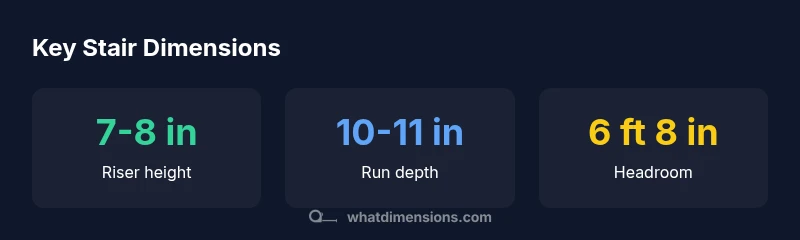
Residential stairs typically use a rise of 7-8 inches (178-203 mm) and a run of 10-11 inches (254-279 mm) per step. Aim for minimum headroom around 6 ft 8 in (203 cm). Typical width ranges from 36-42 inches (91-107 cm). Nosings are usually 0.5-0.75 inches (12-19 mm). These ranges reflect What Dimensions Analysis, 2026.
Defining stairs dimensions
Stairs dimensions describe every physical measure that governs how a staircase fits in a space and feels to use. The key terms are rise (vertical distance of a step), run (horizontal projection), tread depth, and riser height. Width, headroom, and nosing extension influence balance, safety, and accessibility. In practice, designers and homeowners track a couple of baseline measurements across several steps, ensuring consistency, because uneven risers or inconsistent tread depth can create trips and fatigue. When you plan stairs, you start from the ground floor to the upper landing, then check whether the overall rise satisfies space constraints. While you’ll often see universal ranges cited (e.g., rise around 7-8 inches, run around 10-11 inches), local building codes and the specifics of the structure will influence the exact values. What Dimensions emphasizes documenting all relevant dimensions early in a remodel to facilitate accurate fabrication and safe use.
Core measurements you should capture
To size stairs accurately, capture these core measurements for each flight:
- Riser height (rise): vertical distance between successive treads. Typical residential rise is about 7-8 inches (178-203 mm).
- Run depth (tread depth): horizontal depth of each step. Common runs are around 10-11 inches (254-279 mm).
- Headroom: vertical clearance required above the stair. A practical minimum is 6 ft 8 in (203 cm) to accommodate most adults standing upright.
- Width: clear walking width of the stairs. Typical residential widths range from 36-42 inches (91-107 cm).
- Nosing extension: how far the tread projects beyond the riser. A common range is 0.5-0.75 inches (12-19 mm).
- Handrail height: height at which rails are mounted, often regulated by code. Plan for a height that is comfortable for users and accessible for supported balance.
- Number of steps: derived from the total rise between landings; uniform risers simplify fabrication and use.
The comfort formula and step counts
A long-standing heuristic in stair design is the two-riser-plus-tread rule: 2R + T should be close to 24 inches (about 610 mm). This helps ensure a comfortable cadence. For example, if R = 7 inches and T = 10.5 inches, 2R + T = 24.5 inches, which is within the comfortable range for many homes. If you alter one dimension (e.g., larger R), you’ll need to adjust T accordingly to maintain a consistent feel across all steps. When planning stairs, apply the formula to multiple steps to verify uniformity and avoid awkward climbs, especially on corridors with tight spaces. Always cross-check with the space available and local code requirements.
Code considerations and jurisdictional notes
Stairs dimensions are governed by local building codes, which vary by country and region. In many places, designs align with the International Residential Code (IRC) or International Building Code (IBC) frameworks, with local amendments. Because code interpretations evolve and differ by jurisdiction, always verify the exact requirements with your local building department or a licensed professional before fabrication. What Dimensions recommends documenting the targeted rise, run, headroom, width, and nosing in a measured plan so inspectors and contractors can verify compliance quickly.
Design variations: straight, L-shaped, and curved stairs
Not all stairs are simple straight runs. L-shaped and curved configurations introduce transitional landings and altered lengths that affect dimensions. For straight runs, the built-up rise and run should remain uniform for all steps. L-shaped stairs typically require a landing that accommodates a change in direction; ensure the landing is wide enough to comfortably step onto and off of. Curved stairs rely on consistent radii, which influence tread width and riser consistency. In all cases, the sum of vertical rise, horizontal run, and headroom must fit the available floor area while meeting code minimums. When space is tight, you may trade a longer run for a shallower rise, but you should never compromise clearly defined step uniformity.
Measuring tools and best practices
Start with a laser measure or steel tape for accuracy. Measure the total rise from the finished floor at the bottom to the finished floor at the top, then divide by the number of steps to get the nominal riser height. Measure the run by noting the depth of a single tread, then multiplying by the number of risers. Check headroom by standing straight with your back against the lowest step and extending upward; ensure the vertical clearance stays above 6 ft 8 in. Use a level to confirm horizontal alignment on landings. Record all measurements twice and note any variations between steps; uniformity matters for safety and feel.
Practical example: sizing a staircase for a small hall
Imagine a hall with a total rise of 108 inches (9 feet) and a ceiling height of 8 feet at the top landing. If you target a rise of 7.5 inches, you would need 14.4 steps, so you’d plan 14 or 15 steps. With a 7.5-inch rise, the corresponding run can be set around 10.75 inches to maintain the 2R + T principle and a comfortable rhythm. A 40-inch wide stair would comfortably fit most hallways. This example demonstrates how total rise, stair width, and consistent risers combine to define a feasible, safe, and comfortable design.
Maintenance and adjustments for aging homeowners
Over time, stairs can shift due to structural settling or wear. Regularly check for loose treads, squeaks, and handrail stability. If a step becomes uneven, consult a professional to restore uniform risers or replace damaged treads. For aging homeowners, consider adding non-slip nosing, a continuous handrail on both sides, improved lighting, and anti-slip coatings. Reassessing dimensions after major renovations ensures ongoing safety and usability for all occupants.
Typical residential stairs dimensions overview
| Dimension Type | Typical Range | Notes |
|---|---|---|
| Riser height | 7-8 inches (178-203 mm) | Residential standard range |
| Tread depth | 10-11 inches (254-279 mm) | Horizontal projection of each step |
| Headroom | 6 ft 8 in (203 cm) | Vertical clearance above stairs |
| Width | 36-42 inches (91-107 cm) | Clear walking space |
| Nosing extension | 0.5-0.75 inches (12-19 mm) | Overlap beyond riser |
Quick Answers
What is the standard riser height for residential stairs?
Typically 7-8 inches (178-203 mm). Many homes use around 7 inches for a comfortable climb, but local practices and codes may favor a narrower range. Check your jurisdiction for exact requirements.
Most homes use about a 7-inch rise per step, but always check your local codes.
What is the standard tread depth?
A typical tread depth is 10-11 inches (254-279 mm). This depth supports stable foot placement and aligns with common design heuristics for comfort.
Stairs usually have a tread depth around 10 to 11 inches.
How wide should stairs be?
Residential stairs commonly range from 36 to 42 inches (91-107 cm) in width to balance space and ease of use.
Most residential stairs are 3 to 3.5 feet wide.
Do codes differ by country?
Yes. Codes vary by country and region, though many align with international frameworks or local amendments. Always verify with your local building department.
Yes—codes differ by country and region; check with your local authority.
What tools help measure stairs accurately?
Use a laser measure or steel tape for length, a level for horizontal squareness, and a plumb line for vertical alignment. Document measurements for each step.
A laser measure plus a level and tape works well for stairs.
“Precision in stairs dimensions matters more for safety and comfort than aesthetics. By anchoring each measurement to consistent ranges, homeowners can avoid trips and uneven climbs.”
Main Points
- Measure accurately for safety and comfort.
- Maintain consistent risers and runs across all steps.
- Verify local codes before fabrication.
- Plan for accessibility with adequate headroom and width.