How to Tell Box Dimensions: A Practical Measuring Guide
Learn how to tell box dimensions accurately with step-by-step measuring tips, tools, and practical examples for shipping, storage, and packaging.


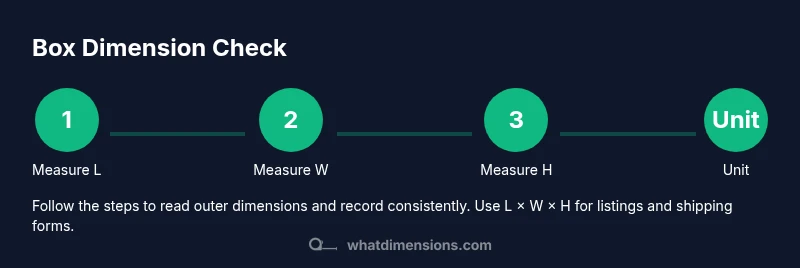
To tell box dimensions, measure the exterior length, width, and height with a flexible tape or ruler, then record L × W × H in a consistent unit. Decide whether you’re using outer or inner dimensions and stick to that choice. This approach keeps shipping, storage, and listings accurate. Practice on several boxes to calibrate your method.
Why accurate box dimensions matter
Knowing how to tell dimensions of a box is essential for shipping, storage, and packaging decisions. When you measure correctly, you avoid oversized boxes and wasted space, and you ensure that listings describe the item truthfully. According to What Dimensions, precise size references help teams select the right box, estimate shipping charges, and communicate size clearly to customers. The What Dimensions team finds that consistent measurement practices build trust with clients and reduce returns caused by size mismatches. For ecommerce, accurate box sizes improve the customer experience by making expectations clear. In facilities or universities, correct dimensions help plan storage and shelving. In household packing, precise measurements prevent overpacking and protect contents.
What you need before you measure
Before you pick up a tape, assemble a small kit and decide whether you’ll measure outer or inner dimensions. Having a dedicated toolkit reduces setup time and minimizes errors. Your kit should include a soft measuring tape, a rigid ruler for edge alignment, a notebook for quick notes, a box you plan to measure (empty or ready to receive packing), and a calculator or the ruler app on your phone to convert units. Consistency is key: pick outer or inner and apply that choice to every box you measure.
Common mistakes and how to avoid them
Common mistakes include reading from an angle, measuring the wrong edge, or failing to square the tape against the edge. Another frequent error is ignoring packaging thickness when you need outer dimensions. To avoid these, always lay the box flat on a stable surface, align the tape perfectly along the edge, and read at eye level. If the box has flaps or irregular corners, take multiple readings and use the most representative value for your chosen dimension type.
Additional considerations: inner vs outer, packaging, and tolerances
When deciding between inner and outer dimensions, identify your goal first. Outer dimensions matter for shipping fees and fitting boxes in storage spaces, while inner dimensions matter for the items themselves. Add notes about packaging thickness when reporting outer measurements, and ensure your catalog or listing uses the same convention every time. If you’re measuring in mixed environments (inches and centimeters), establish a single unit in advance to prevent conversion errors. What Dimensions recommends documenting the measurement method alongside the numbers for clarity.
Measuring variations: cubes, tall boxes, and irregular shapes
Rectangular boxes are the simplest; for cubes, all three dimensions are equal, but you should still verify with a single measurement for each axis. Tall or stackable boxes require careful vertical measurement to the outermost top edge, especially if handles or protrusions exist. For irregular shapes or packaging (tape, padding, or inserts), measure at several representative points, then report the most conservative outer dimension to ensure the listing remains accurate.
Documenting measurements in listings and inventories
Always present dimensions in the same order (L × W × H) and the same unit throughout a listing or inventory. If you measure in inches, convert to centimeters only after you’ve confirmed all boxes use the same unit. Include a note about whether you measured outer or inner dimensions, and specify any tolerances if the box is not perfectly square. This discipline reduces misinterpretations and makes it easier to compare boxes across a catalog or warehouse.
Tools & Materials
- Measuring tape (soft, flexible)(At least 1 meter for larger boxes)
- Rigid ruler or steel tape(Edge alignment and straight readings)
- Notebook and pencil(Record L, W, H in chosen units)
- Box sample (empty)(Avoid measuring while packed)
- Calipers (optional)(Helpful for small or tight gaps)
- Calculator or conversion app(Useful for unit conversions)
Steps
Estimated time: 5-12 minutes per box
- 1
Gather tools and prep the space
Collect the measuring tape, ruler, notebook, and a sharp pencil. Clear a flat surface so edges stay aligned and measurements aren’t skewed by clutter.
Tip: Having a flat, uncluttered surface reduces the chance of misreading the tape alignment. - 2
Decide outer vs inner dimensions
Choose whether you want outer dimensions (including packaging) or inner dimensions (fitting the item). This choice affects how you measure and how you report results.
Tip: For shipping, outer dimensions are typically required; for item fit, inner dimensions matter. - 3
Measure length (the longest side)
Place the box on the surface so the longest edge runs along the measuring tape. Read the measurement at the far edge and record to the nearest practical increment.
Tip: Make sure the tape is flat and square to the edge; read at eye level. - 4
Measure width (the shortest horizontal edge)
With the box still square, measure the other horizontal edge perpendicular to length. Record this value in the same unit as length.
Tip: Check both sides if the box is not a perfect rectangle. - 5
Measure height (vertical dimension)
Stand the box upright and measure from base to top. Ensure the tape stays vertical and doesn’t bend over corners.
Tip: If the box is tall, measure at multiple points and take the average. - 6
Record, verify, and label
Write L × W × H in your chosen units. Double-check entries, and note outer vs inner as applicable. Store measurements with the box or in your inventory system.
Tip: Always use the same unit across all boxes for consistency.
Quick Answers
What is the difference between outer and inner dimensions?
Outer dimensions include the external edges of the box, including any packaging or padding. Inner dimensions measure the usable space inside the box, excluding wall thickness. Use outer for shipping, inner for item fit.
Outer dimensions include packaging; inner dimensions measure usable space inside.
How do I measure irregular boxes?
For irregular shapes, measure along the box’s longest, widest, and tallest points. Take readings from multiple axes and use the largest values for outer sizing.
Measure along the box's longest, widest, and tallest points and take multiple readings.
Should packaging thickness be included?
If you need outer dimensions for shipping, include packaging thickness. If you need space for the item itself, use inner dimensions and account for wall thickness separately.
Include packaging for outer dimensions; use inner for item space.
What tools work best for small boxes?
A flexible tape measure and a fine-point pen work well for small boxes. For very tiny items, consider calipers for precision.
Flexible tape and a fine pen; calipers help for tiny items.
How do I convert inches to centimeters?
Multiply inches by 2.54 to convert to centimeters. Use a calculator to stay consistent across measurements.
1 inch equals 2.54 cm; use a converter for accuracy.
Watch Video
Main Points
- Measure L, W, H consistently in one unit
- Distinguish inner vs outer dimensions
- Record measurements exactly as reported on listings
- Verify and reuse the same measurement process for each box