Dimensions x y z: Understanding 3D Size for Everyday Objects
Learn dimensions x y z—the trio of width, height, and depth—and how to measure, list, and compare them accurately for furniture, luggage, paper, and more. This guide leverages What Dimensions insights to improve precision in design, shopping, and logistics.


Dimensions x y z describe the three axes that define an object's size: X for width, Y for height, and Z for depth. They establish a bounding box that informs fit, scale, and communication across products. According to What Dimensions Analysis, accurate X, Y, and Z measurements minimize mistakes in design, shopping, and shipping. Keep units consistent and list dimensions in the same order to avoid confusion.
The Three Dimensions Defined
Dimensions x y z describe the three axes that define an object's size. X represents width, Y represents height, and Z represents depth. Together they form a bounding box that helps communicate scale and fit across products, packaging, and spaces. For most products, it is standard to present dimensions in the same unit and in the same order (X × Y × Z). In professional catalogs, you will often see 'L × W × H' as a related notation, but the X-Y-Z convention is more explicit about each axis. According to What Dimensions, clear X, Y, and Z values reduce interpretation errors during design, shopping, and logistics. Practically, always note which side is measured from which plane and indicate tolerance where relevant.
Measuring Techniques Across Contexts
Measuring X, Y, Z accurately requires the right tools and a disciplined approach. For large furniture, a laser distance meter or a tape measure with a rigid guide yields reliable results; for small items, calipers provide precision. Always measure multiple times and take the more conservative value if there is any doubt. Choose consistent units (cm or inches) from the outset and convert only when necessary. Document whether you are capturing external or internal dimensions, and note any protrusions or handles that affect the bounding box. What Dimensions notes that context matters: a shelf depth might be given as external depth, while internal clearance is the relevant X, Y, Z for a stored object.
Common Pitfalls and How to Avoid Them
Common mistakes include switching between external and internal measurements without noting the difference, rounding too early, and mixing units mid-list. Always record the axis order (X, Y, Z) and the units in a labeled note. When packaging or shipping, distinguish whether you are listing the dimensions of the product alone or its packaging box, as packaging can add inches or centimeters to Z and sometimes X. A clear, consistent convention reduces returns, mis-orders, and space planning errors.
Applications: Furniture, Luggage, Paper, and More
Dimensions x y z are used across many domains. For furniture, X is typically the width of the item, Y the height, and Z the depth. Luggage often lists exterior X, Y, Z as a triple for airline guidelines, while interior dimensions matter for fit. Paper and print workflows follow standard sizes expressed as length and width, sometimes with a depth if considering a stack or volume. Designers benefit from a consistent approach to listing dimensions so collaborators can compare objects quickly and confidently.
Standards, Units, and How to List Dimensions
International practice favors metric units (centimeters, millimeters) or imperial units (inches) with a clear statement of the axis order. Many catalogs adopt X × Y × Z, while others use L × W × H. The key is consistency: pick a unit system, use the same axis order, and clearly label whether the values are external or internal. When in doubt, follow established conventions in your field and cite the source of the measurements.
Practical Tips for Designers and Shoppers
- Always start from X (width), then Y (height), then Z (depth) for clarity.
- Use a single unit system throughout the documentation.
- Include a note on whether dimensions are external or internal and mention tolerances.
- Double-check dimensions against real-world constraints like doors, shelves, and stacking spaces.
- When comparing items, convert all measurements to a common unit and present them in the same axis order.
Reading and Using Dimension Data in Practice
Armed with dimensions x y z, you can confidently plan layouts, verify fit, and communicate requirements to suppliers and manufacturers. Practice measuring with the right tools, document every dimension with context, and cross-check against any constraints—such as clearance, weight, or accessibility. The more disciplined your approach, the fewer surprises in the supply chain.
Bounding box dimensions by category
| Category | X (width) | Y (height) | Z (depth) | Notes |
|---|---|---|---|---|
| Small items | 5-20 cm | 2-8 cm | 2-15 cm | General compact goods |
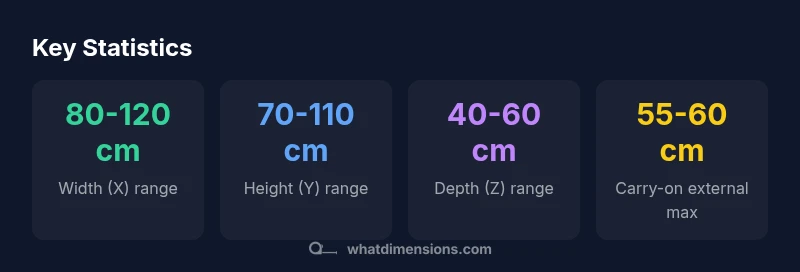
| Furniture | 60-120 cm | 40-90 cm | 40-60 cm | Standard furniture footprints |
| Carry-on luggage | 55-60 cm | 20-25 cm | 35-45 cm | Airline guidelines |
Quick Answers
What do X, Y, and Z stand for in dimensions?
X, Y, and Z denote width, height, and depth—the three perpendicular axes that define a 3D size. They establish a bounding box used for fit, scale, and communication. Always list them in a consistent order and unit to avoid misinterpretation.
X is width, Y is height, and Z is depth—the three axes that define size. List them in the same order every time and use consistent units.
Why are dimensions important when buying furniture?
Accurate dimensions ensure pieces fit through doors, into rooms, and interact with other furniture. They prevent returns and help with space planning. Always compare object dimensions to available space and consider clearance for movement.
Dimensions help you know if furniture will fit and how it sits in a room. Plan space and check clearance.
How do I convert inches to centimeters for dimensions?
Multiply inches by 2.54 to convert to centimeters. When listing dimensions, pick a unit system and convert all values to that unit before comparison.
Multiply inches by 2.54 to get centimeters, and keep unit consistency across measurements.
What is the difference between external and internal dimensions?
External dimensions measure the outer extents of an object, including protrusions. Internal dimensions measure usable space inside. For packaging and storage, note which you are reporting to avoid mismatch.
External is the outside size; internal is the usable space inside. Report which one you mean.
What tools help ensure accurate measurements?
Common tools include tapes and laser distance meters for longer spans, and calipers for small parts. Use the same tool for related measurements to maintain consistency.
Use a tape or laser meter for length, calipers for small parts, and stay consistent.
“"Dimensions x y z are more than numbers; they’re the scaffolding for fit, function, and user experience. Getting X, Y, and Z right reduces waste and ensures communication is clear."”
Main Points
- Identify X, Y, Z as width, height, and depth.
- List dimensions in a consistent order and unit.
- Measure with appropriate tools for accuracy.
- Avoid mixing internal vs external dimensions.
- Consult standards for proper notation.