Dimensions when measuring a box: a practical How-To
Learn how to precisely measure a box with clear steps, tools, and tips. This guide covers external vs internal dimensions, common mistakes, and practical examples to ensure accurate box dimensions for shipping, storage, and packing.


To measure a box accurately, record its external length, width, and height in the same unit you’ll use for shipping or storage, noting whether you’re measuring outside or inside. Start with the exterior dimensions, check for irregular corners or flaps, and account for packaging materials. Use consistent units, round to the nearest millimeter or inch, and double‑check with a second measurement.
Why precise dimensions matter when measuring a box
In logistics and everyday organization, the phrase dimensions when measuring a box isn't just about numbers—it's about ensuring fit, protecting contents, and controlling costs. According to What Dimensions, precise box dimensions help reduce shipping costs, prevent damage during transit, and improve inventory planning for warehouses and homes. The goal is to establish a reliable baseline you can reuse across applications: packing, storage, and even returns. When you measure, you’ll determine how much space the item occupies, whether it will fit into a shipment, and how much packaging material you should allocate. This requires consistent units, a clear decision about external vs internal measurements, and a method you stick with over time. By focusing on dimensions when measuring a box, you minimize surprises and build a repeatable workflow you can apply to lamps, books, electronics, or office supplies. What Dimensions suggests documenting each box with a short label that includes the three primary dimensions and the unit used.
Defining the three core dimensions
Dimensions for any box are typically broken down into three core measurements: length, width, and height. Length is often the longest side when the box sits with its face flat on a surface, width is the side perpendicular to length, and height is the vertical dimension. When you’re measuring for packaging or storage, decide whether you’ll record external or internal dimensions and be consistent. External dimensions describe the outer envelope of the box, including any flaps or cosmetic overhangs; internal dimensions reflect the usable interior space. For most shipping and inventory tasks, external measurements are the standard reference because they determine fit with pallets, shelves, and carrier constraints. Document the units you use (inches or centimeters) and ensure all three numbers are taken in the same unit for clarity and easy comparison.
External vs internal dimensions: what to measure and why
The distinction between external and internal dimensions matters for different use cases. External dimensions include the outer walls, flaps, and any packaging that adds thickness to the box. Internal dimensions measure the hollow space inside the package, which is critical when packing items that require a precise fit or when calculating payload. In practice, you’ll often start with external measurements to assess fit within shipping containers, then check internal dimensions if you need to confirm that the item will slide in without forcing the box shut. Always clearly label which set you’re using (external vs internal) to avoid confusion in packing lists, storage databases, or return workflows.
Common measurement mistakes and how to avoid them
Even small mistakes compound quickly. Rushing through measurements can lead to inconsistent results, especially if you alternate between external and internal measurements. Common errors include measuring from the wrong edge, using a bent ruler, or failing to account for the thickness of the tape or packaging. To avoid these pitfalls, always measure from edge to edge with the box resting flat, use a straight ruler or a flexible tape for longer boxes, and record all three dimensions consecutively (L x W x H). Double-check by measuring again, ideally with a different tool (tape measure and ruler) to confirm consistency. When possible, measure multiple copies of the same box to determine an average, which can reduce random error in bulk operations.
Measuring irregular shapes and nested boxes
Not every box is a perfect rectangular prism. Irregular corners, curved edges, or nested packaging complicate measurement. For irregular shapes, measure the maximum distance along each axis (the furthest point along length, width, and height) to capture the true footprint. For nested boxes or boxes with inserts, measure the outer dimensions first and then the internal cavity. For containers with handles or protruding features, note how these features affect the envelope size you’ll actually use in packing or shipping. In ambiguous situations, document both the maximum outer dimensions and the practical usable dimensions, and keep a quick reference guide for teams.
Recording, labeling, and storing measurements
A consistent labeling system saves time and reduces errors in warehouses, classrooms, and homes. Record: 1) the box identifier or SKU (if applicable), 2) the three dimensions, 3) the units used (in or cm), 4) whether the measurement is external or internal, and 5) the date of measurement. Store this in a digital log or a simple notebook with a clear, searchable format. If you’re repeating measurements for many boxes, consider creating a template that auto-populates the L, W, H fields and a note column for special features like flaps or handles. Regular audits of your logs help catch drift or recurring mistakes before they propagate.
Real-world scenarios: packing, shipping, and storage
When you’re packing, accurate box dimensions enable you to choose the right box size and packing materials, preventing wasted space or damaged items. For shipping, correct dimensions ensure you meet carrier requirements and avoid surcharges or delays caused by misclassification. In storage, consistent dimensions simplify stackability and shelf labeling. By integrating dimensions when measuring a box into workflows, you improve efficiency, reduce returns due to improper fit, and support better inventory management. What Dimensions emphasizes that precision here translates to tangible savings and smoother operations.
Quick-start checklist
- Decide whether to use external or internal dimensions and stick to it.
- Gather your tools: measuring tape, a straight edge, and a log.
- Measure length, width, and height in the same unit for all boxes.
- Double-check each measurement with a second pass or a different tool.
- Label and store measurements in an organized log for easy retrieval.
- Review any irregularities or packaging features that affect usable space.
Authority sources
- https://www.nist.gov/topics/measurement-science
- https://about.usps.com/who-we-are/our-facilities/packaging-tips.htm
- https://www.sba.gov
Tools & Materials
- Measuring tape(Prefer a flexible tape with both metric and imperial units; 150 cm (60 in) minimum length recommended for larger boxes)
- Rigid ruler or steel yardstick(Useful for cross-checking straight edges on small boxes)
- Notepad or measurement log(Record L, W, H, units, and whether external/internal)
- Pencil or marker(Label measurements clearly on the notebook or box itself for quick reference)
- Calipers (optional)(Precise for thin-walled or small-box measurements; helpful for internal dimensions on tight fits)
Steps
Estimated time: 15-25 minutes
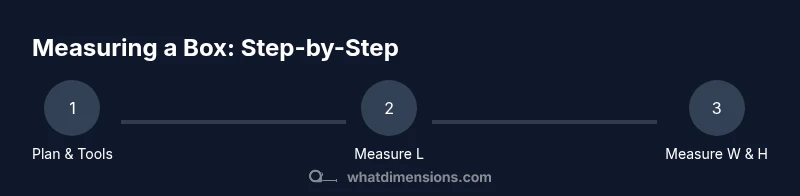
- 1
Gather tools and decide measurement type
Collect the ruler, tape measure, and notebook. Decide in advance whether you will record external or internal dimensions and be consistent across all boxes you measure.
Tip: Starting with a plan reduces back-and-forth and ensures comparability between boxes. - 2
Place the box on a flat surface
Set the box on a stable surface with all faces flat to ensure accurate edge alignment. If the box is closed, use the outermost points; if open, measure the relevant outer envelope.
Tip: Close the flaps if you’re measuring external dimensions to reflect the true outer size. - 3
Measure length (L)
Align the ruler with the box’s longest edge and record the distance. Take two measurements at different points to verify consistency.
Tip: If the box is long and awkward, use the tape measure for the initial pass and confirm with a ruler. - 4
Measure width (W)
Measure perpendicular to length across the box’s shortest width. Use the same edge reference to avoid skewed results.
Tip: Check for any protrusions that might extend the perceived width and note them in the log. - 5
Measure height (H)
Measure from the base to the top edge, accounting for any top flaps or labeling on the exterior of the box.
Tip: For tall boxes, a step stool can help you maintain a straight vertical measurement. - 6
Record units and orientation
Write down whether you used external or internal dimensions and confirm the units (inches or centimeters) for all three measurements.
Tip: Consistency matters—mixing units later leads to errors in packing or shipping calculations. - 7
Double-check with a second pass
Repeat each dimension with a fresh measurement to catch slips or parallax errors. If available, use a different tool as a cross-check.
Tip: A small discrepancy (e.g., ±1 mm) is normal; document the tolerance in your log. - 8
Label and store the measurement
Attach a label to the box or record in your log with the three dimensions and the date. This makes future references fast and reduces misfits.
Tip: Organize measurements by product line or shipment batch to simplify retrieval.
Quick Answers
What is the difference between external and internal dimensions?
External dimensions describe the outer envelope of the box, including flaps and walls. Internal dimensions refer to the usable space inside the box. The choice depends on the task, but external dimensions are usually used for shipping and storage planning.
External dimensions cover the outer size, while internal dimensions measure usable space inside the box.
How do I measure a box with flaps or irregular edges?
Close flaps and measure the outermost edges for external dimensions, or open and measure the inner cavity for internal dimensions. For irregular edges, measure to the furthest point on each axis.
Close the flaps to measure the outside, or measure the inside cavity for usable space.
Which units should I use for documentation?
Choose either inches or centimeters and apply it consistently to all measurements. If working with multiple teammates, standardize the unit across the entire project.
Pick one unit—improve consistency by sticking with it.
How can I convert between inches and centimeters quickly?
1 inch equals 2.54 centimeters. Use a calculator or a quick conversion chart to avoid errors, especially when logging numerous boxes.
Remember: 1 inch is 2.54 cm; use a calculator for many boxes.
What if a box is not a perfect rectangular prism?
Measure the maximum extents along each axis to capture the true footprint. For nested packaging, record both outer and usable inner dimensions where relevant.
For irregular boxes, measure the furthest points along each axis.
How should I store box measurements for quick access?
Keep a simple log or spreadsheet with columns for ID, L, W, H, units, and type (external/internal). Regularly audit records to catch drift.
Maintain a labeled log with clear fields and dates.
Watch Video
Main Points
- Measure length, width, and height consistently in the same units.
- Clearly differentiate external vs internal dimensions in all records.
- Double-check measurements to minimize errors.
- Document and label every box for easy reference.
- Account for packaging and irregular features that affect usable space.