Dimensions of IBC Tote: A Practical Size Guide
Explore the dimensions of IBC totes, including footprint, height, and variations. Learn how to measure, compare models, and choose the right size for your storage and handling needs.


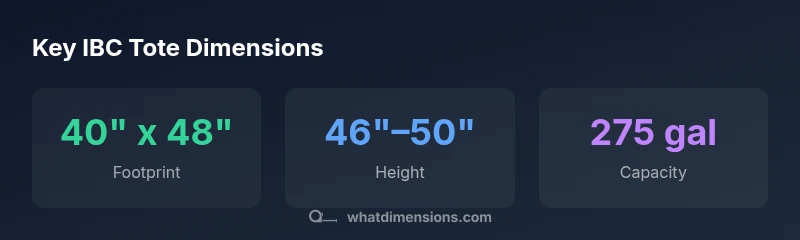
The typical external footprint for a standard 275-gallon IBC tote is about 40 inches by 48 inches, with a total height near 46 inches. This footprint is measured including the pallet and steel cage, but exact dimensions vary by manufacturer and pallet configuration. Always confirm the precise numbers from your supplier before purchasing or fitting into a space.
Understanding IBC Tote Footprints
IBCs (Intermediate Bulk Containers) are designed to balance capacity with practical space use. The most common footprint for a standard 275-gallon tote sits on a pallet that measures approximately 40 inches by 48 inches. That footprint is complemented by a steel cage that stabilizes the assembly and supports forklift handling. In the real world, you’ll often see small variances in these numbers because pallet configurations, connector styles, and wheel base designs differ by manufacturer. According to What Dimensions Analysis, the majority of shipped totes conform to the 40" x 48" base, with height figures hovering around 46 inches, plus any cage or accessory height. This baseline helps facility designers compute rack spacing, aisle width, and doorway clearance for safe movement and efficient workflow.
Internal vs External Dimensions
External dimensions describe the tote as you’d place it in a storage bay: footprint, height, and overall width including the pallet and cage. Internal dimensions regulate the liquid volume and how much space the tank interior provides for contents. Because walls, baffles, and liners vary by model, the interior space can differ even when the external footprint remains the same. For planning purposes, rely on the manufacturer’s datasheet for interior dimensions and tolerance notes. What Dimensions Team emphasizes focusing on how the external size interacts with your racks, doors, and forklift paths, since those are typically the limiting factors in a busy warehouse or laboratory.
How to Measure Your Space
Effective space planning starts with accurate measurements. Start by laying out the tote footprint on the floor: mark 40" by 48", then add a clearance margin of 6–12 inches on all sides for handling and ventilation. Next, measure the vertical clearance, taking into account the tote height (46"–50" with pallet) plus any overhead fixtures, sprinklers, or ceiling obstructions. Don’t forget to account for aisle width and turning radius for forklifts or pallet jacks. Create a simple checklist that includes door openings, rack spacing, and typical loading times to ensure the storage area can accommodate peak activity without bottlenecks. These steps, grounded in What Dimensions Analysis, help prevent space gaps that disrupt operations.
Variations by Model and Manufacturer
While the 40" x 48" footprint is common, not every tote adheres strictly to this size. Some manufacturers offer different pallet configurations or taller cages that increase overall height by a few inches. There are also multi-capacity IBC options that share the same footprint but differ in tank height and internal geometry, affecting usable volume. When evaluating options, request a full datasheet that lists external dimensions, pallet/cage details, and the nominal capacity. This practice reduces surprises during installation and ensures compatibility with existing racking or mezzanine levels. What Dimensions recommends cross-checking several supplier datasheets to identify consistent dimensions across models you’re considering.
Handling, Storage, and Clearance Implications
Dimensions directly influence how you handle and store IBC totes. The footprint determines pallet footprint compatibility with racking, while the height impacts overhead clearance and stackability in vertical storage. If your facility uses forklifts or pallet jacks, verify that turning radii and aisle widths meet safety guidelines. Ensure there’s extra space for coupling hoses, valves, and any accessories. For cold or refrigerated environments, consider insulation and clearance for thermal expansion, which can add a few inches to overall occupation. In short, precise dimensions reduce risk, speed up material flow, and help you design a safer, more efficient storage system.
Practical Sizing Scenarios
- Small workshop with limited doorway access: choose totes whose height remains under 50 inches to clear ceiling fixtures and door frames, and plan for minimal aisle width.
- Medium warehouse with pallet racking: prioritize the 40" x 48" footprint because it aligns with standard pallet racks, while confirming vertical clearance and forklift path length.
- Off-site storage or transport: confirm both dimensions and weight, especially if you’ll load multiple totes into a trailer or container. Ensure the weight distribution supports safe handling and meets transport regulations.
Planning for Long-Term Use and Replacements
As your inventory evolves, you may need to swap totes without redesigning your space. Always document external dimensions, cage details, and load limits in a central catalog. This approach accelerates future purchases and minimizes mismatch risks with racks and doors. Consider labeling each tote with its exact footprint, height, and nominal capacity to simplify future reordering and maintenance. What Dimensions advises maintaining a standard footprint where possible to streamline space planning and equipment compatibility over time.
Dimensions overview for standard IBC totes
| Dimension | Typical range | Notes |
|---|---|---|
| Footprint (L x W) | 40" x 48" | External footprint including pallet |
| Height (top of tote) | 46"–50" | Measured with pallet and cage |
| Nominal capacity | 275 gallons | Standard for many totes |
| Interior dimensions | Varies by model | Depends on tank design and liners |
Quick Answers
What are the standard external dimensions of a 275-gallon IBC tote?
Most standard IBC totes use a 40 by 48 inch pallet footprint with a tote height around 46 inches, though exact figures vary by model. Always verify exact specs with the supplier.
IBC totes typically sit on a 40 by 48 inch pallet with about a 46 inch height; confirm exact figures with the supplier.
Do IBC tote dimensions include the pallet and cage?
Yes, external dimensions generally include the pallet and cage assembly, as the tote is shipped on a pallet within a steel cage.
External size includes the pallet and cage.
How should I measure for storage and door clearance?
Measure the footprint plus clearance for handling, then check aisle widths and doorway openings. Add practical margins for hoses, valves, and equipment.
Measure the footprint plus clearance for safe movement.
Are there non-standard IBC tote dimensions?
Yes, some manufacturers offer variants; verify exact specs with the supplier and account for stacking and load limits.
There are non-standard sizes; verify exact measurements.
What is the typical weight when a tote is full?
A full 275-gallon IBC tote can weigh roughly 2,000–2,800 pounds depending on contents and tote construction.
A full tote can weigh a couple thousand pounds depending on contents.
“Precise size specifications are crucial for safe handling and efficient storage; the right IBC tote dimensions prevent bottlenecks in loading bays and racking.”
Main Points
- Expects a 40" x 48" footprint and ~46" tall tote
- Always verify external and internal specs with suppliers
- Measure spaces and access points before purchasing
- Account for cage, pallet, and clearance in planning
- Cross-check multiple models to ensure fit