Dimensions in Hair Salon and Barbershop: A Precision Guide
Explore how exact dimensions shape client comfort, staff workflow, and accessibility in hair salons and barbershops. What Dimensions guides precise layout, furniture footprints, and best practices for sizing that scales across space sizes.


Exact dimensions influence client comfort, staff efficiency, and accessibility in hair salons and barbershops. The most critical measurements include workstation width, aisle clearance, chair footprint, mirror placement, and service-bay depth. By planning around these figures, designers can improve space flow, reduce congestion, and support compliant, inclusive layouts. What Dimensions emphasizes consistent footprints and scalable layouts to accommodate different space sizes while maintaining usability for clients and stylists.
Dimensions in hair salon and barbershop: why size matters
Dimensions in hair salon and barbershop shape daily operations and client perception. A space that feels roomy reduces anxiety and helps staff move with confidence. Conversely, cramped layouts slow down services and hinder sanitization workflows. In practice, designers aim for a balance between generous circulation and compact efficiency. The What Dimensions team notes that consistent footprints, even in small spaces, support faster service times and more predictable staffing needs. This becomes especially important for peak hours when every inch of space counts. Beyond comfort, proper sizing supports accessibility for clients with mobility aids and parents with strollers, aligning with universal design principles and ADA guidelines.
From a design perspective, you’re balancing two forces: the need for open, navigable space and the reality of finite square footage. In many markets, salons and barbershops operate with 1–2 service bays per station, a design choice that optimizes staff reach while reducing travel distance between chairs, sinks, and stations. What Dimensions emphasizes starting with a baseline grid—think modular units that can scale up or down—so you can adapt layouts as service offerings expand or contract.
For homeowners and designers, this means prioritizing measurable footprints over aesthetics alone. Accurate dimensions help you specify furniture footprints, confirm sightlines to mirrors, and ensure staff can move without collisions. Including accessibility in the early design discussion saves retrofit costs and makes spaces usable by a broader range of clients. The result is a space that feels comfortable, efficient, and compliant from day one.
Core dimension categories that drive layout decisions
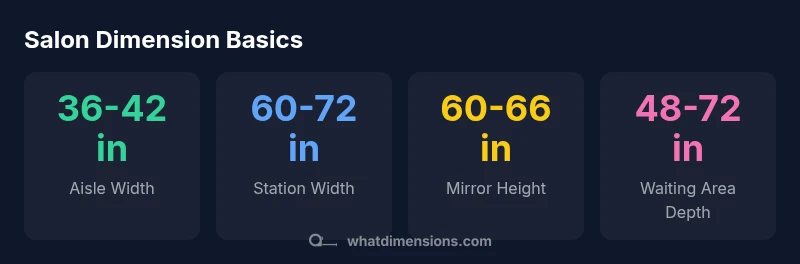
Layout decisions hinge on several dimension categories that repeatedly appear in salon and barbershop projects. Aisle width determines movement for clients and stylists; station depth influences service capability and privacy; mirror placement affects visibility and ergonomics for clients of varied heights; and waiting-area depth shapes the pace of check-in and transition between steps in a service. Visibility, reach zones, and quiet zones all rely on accurate measurements. When you combine these categories with modular, repeatable units, you gain the flexibility to reconfigure spaces as your team grows or changes services. This is where What Dimensions’ approach—anchored in empirical sizing and adaptable modules—shows its value, helping designers translate theory into practice while keeping clients at the center of the floor plan.
Ergonomics also plays a critical role. Ergonomic reach zones—areas within comfortable arm and shoulder reach—minimize staff strain during routine tasks such as cutting, rinsing, and cleaning. Proper dimensions support effective sanitization workflows by ensuring unobstructed paths for carts and cleaning equipment. Finally, consider acoustic and lighting implications, which are often controlled by the space, not the furniture alone. Dimensional planning should harmonize with acoustic baffles, task lighting, and mirror placement to create a balanced, human-centered environment.
Furniture footprints and station ergonomics
Furniture footprints determine how many stations fit into a given space and how easily clients navigate around them. A station footprint includes the chair, makeup or styling area, and a small work surface for tools. The aim is to strike a balance between generous working space for technicians and comfortable clearance for clients. Ergonomic considerations go beyond width; depth and height alignment matter for posture and task efficiency. For example, a well-sized styling chair with a reachable trolley reduces the need for operators to twist or lean excessively. In turn, this improves both comfort and productivity over long shifts.
Beyond the chair itself, the nearby workstation should offer enough functional surface without crowding the aisle. Where possible, use modular desks and wall-mounted storage to save floor space while preserving accessibility. The color, texture, and placement of surfaces influence perceived space as well—light colors and reflective surfaces can make a small area feel larger, while darker tones can create a sense of enclosure. These design choices should be tested in sketch models or virtual layouts before committing to a final floor plan.
Measuring accurately: a step-by-step checklist
A rigorous measurement process yields reliable floor plans. Start with a base map of the space, then follow these steps:
- Measure the overall footprint and mark fixed elements (doors, windows, columns).
- Determine aisle widths that allow comfortable two-way traffic with carts and clients.
- Draft station footprints for a typical service flow, including chair placement and trolley reach.
- Verify mirror height works for a typical client range and staff ergonomics.
- Assess waiting-area depth for furniture comfort and circulation.
- Validate clearances around all surfaces for sanitization access and cleaning.
- Run a walkthrough with real staff to test the layout and identify pinch points.
Document any constraints and create multiple scenarios (e.g., expanding services or adding a second chair) to understand how your dimensions adapt. The goal is a flexible yet precise plan that minimizes surprises during build-out or renovation. The process benefits from a collaborative approach across architecture, interior design, and operations teams, ensuring dimensions support both aesthetics and functionality.
Real-world examples: layouts for different footprint sizes
In a compact space (roughly 150–250 square feet), a tight but efficient layout often relies on modular stations and wall-mounted storage. The goal is to maximize service capability while preserving a clear path from the entry to the chair line and the washing stations. In mid-sized salons (roughly 350–500 square feet), you can introduce a more generous waiting area and dedicated shampoo/wash bays, with a clear separation between reception, styling, and washing zones. Large salons (over 1,000 square feet) offer the most flexibility, allowing larger walkways, multiple service bays, and dedicated treatment rooms for specialized services. Across all scales, the core principle remains: measure twice, plan once, and design around predictable client and staff movements. What Dimensions suggests using a modular toolkit so layouts can be reconfigured as needs evolve while preserving a consistent user experience.
In practice, many successful layouts begin with a common configuration: a central aisle, two rows of stations on either side, a dedicated reception desk near the entrance, and a wash area toward the back. However, every space has its own constraints, so use your measurements to tailor the design rather than forcing a generic template. This method reduces back-and-forth adjustments during construction and helps you meet accessibility standards from the outset.
Lighting, sightlines, and the intangible dimensions of a space
Dimensional planning isn’t only about square feet and inches; it also encompasses how light, sightlines, and acoustics shape the client experience. Proper lighting highlights features without glare and helps staff perform precise tasks. Sightlines determine how easily clients can see the stylist’s actions, the mirror, and the product displays, which affects perceived service quality. Acoustics influence comfort in shared spaces yet must be balanced with privacy—sound-absorbing panels can be placed to reduce noise without blocking essential lighting.
To maximize these intangible dimensions, coordinate fixtures with wall surfaces and floor plans. Dimensional planning blends with interior ambiance: the distance between a reception desk and seating should feel inviting, while the mirror’s height and angle should reduce the need for excessive client repositioning. In sum, the best layouts combine precise footprints with thoughtful lighting, sightlines, and acoustic considerations to deliver a seamless, enjoyable experience for every client.
Planning for accessibility and future growth
Accessibility should be embedded in the design from day one. ADA-compliant layouts require clear routes, accessible seating options, and space for mobility devices to navigate. Planning for future growth means selecting modular elements that can be reconfigured without major rebuilds. For example, choosing modular stations that can be separated or merged allows expansion in the future while preserving a comfortable flow. Consider adjustable-height stations and mobile carts to adapt to changing service offerings or staff size. If space allows, reserve a portion of the floor plan for a flexible service area that can serve as a quick-change zone during peak hours or for new services. In this regard, dimension decisions are not just about today’s needs but about how your space will accommodate future changes with minimal disruption.
Salon dimension benchmarks
| Area | Typical Dimension Range | Why it matters |
|---|---|---|
| Aisle width | "36-42 inches" | Ensures comfortable passage for clients and staff |
| Station width | "60-72 inches" | Allows chair, client, and stylist to move freely |
| Mirror height | "60-66 inches" | Optimizes visibility for most clients |
| Waiting-area depth | "48-72 inches" | Accommodates seating while preserving flow |
| Wash bay depth | "48-60 inches" | Supports washing station access and sanitation |
Quick Answers
What are the most important dimensions to measure when planning a salon layout?
Key measurements include aisle width, workstation footprint, mirror height, and service bay depth. Consider accessibility and movement for both clients and staff.
Focus on aisle width, station footprint, and mirror height for a solid layout foundation.
How can I account for client comfort in dimension planning?
Ensure generous circulation around chairs, clear sightlines to mirrors, and comfortable waiting area depth to reduce crowding.
Give guests room to move and see the stylist clearly.
Are there industry standards for salon dimensions?
There are guidelines from ADA and accessibility standards. Use them as benchmarks, but adapt to your space constraints and service mix.
Yes, there are guidelines for accessibility and safe circulation; adapt them to your space.
How should I measure for future growth?
Plan with modular stations and flexible storage. Allow for expansion by reserving space for additional chairs or a second service bay.
Build in modular options so you can grow without a full redesign.
What tools help ensure accurate dimensions?
Use tape measures, laser distance meters, and floor plans. Validate measurements with a staff walkthrough to catch real-world constraints.
Have the team measure together to avoid overlooked angles.
“Precise dimensions aren’t only about fit — they enable efficient workflows, inclusive design, and consistent service quality across every chair.”
Main Points
- Plan layouts with clear walkways to reduce bottlenecks
- Choose furniture footprints that fit standard dimensions
- Prioritize accessibility and sightlines in every decision
- Test layouts with real staff walkthroughs before finalizing
- Use modular, scalable components to future-proof the space