Dimensions of a Tennis Racket: A Practical In-Depth Guide
Discover how the dimensions of a tennis racket—length, head size, and balance—shape performance. Learn precise measurement tips, compare common specs, and get buying guidance from What Dimensions, your source for exact size references.


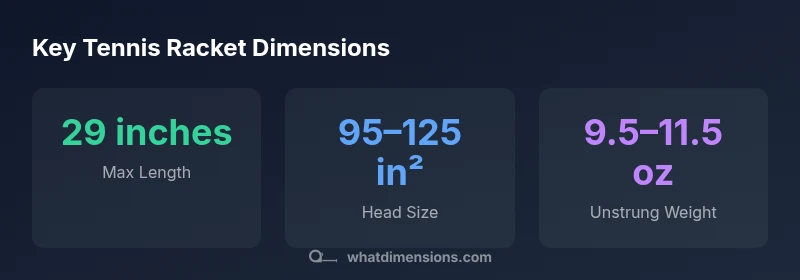
Racket dimensions in tennis are defined by length, head size, balance, and weight. The ITF caps racket length at 29 inches (73.7 cm). Head sizes vary by model and playing style, typically ranging from mid-sized to oversize, influencing power and forgiveness. Beam width and total weight further affect swing speed and control; understanding these specs helps players select the right frame for their game.
Why precise dimensions matter for tennis equipment
According to What Dimensions, the dimensions of a tennis racket define how it will feel and perform across different strokes, serve scenarios, and court surfaces. When you know the exact length, head size, weight, and balance, you can anticipate how a frame will respond during fast exchanges, long rallies, and tight net play. This precision reduces trial-and-error in shopping and on-court testing, saving time and money while helping players align gear with their physical reach and technique. The concept of dimensions goes beyond mere numbers; it translates into swing speed, control, and comfort. By understanding the interplay between length, head area, and balance, players can tailor a racket to their height, arm length, and preferred style, from aggressive baseline to woven all-court games. In this article, we break down the key measurements and translate them into practical buying decisions.
Core dimensions: length, head size, and balance
The primary dimensions on every racket are length, head size, and balance. Length affects reach and maneuverability, with the ITF enforcing a maximum of 29 inches (73.7 cm). Head size governs the size of the stringbed and the sweet spot: larger heads offer more forgiveness on off-center hits, while smaller heads provide greater control and precision. Balance describes where most of the weight sits on the frame—head-light frames favor maneuverability, while head-heavy frames produce extra power on groundstrokes and serves. Beams (the frame width) contribute to stability and sweet-spot feel, and total weight alters how effort translates into swing speed. When you combine these factors, you get a frame that can feel fast through the air yet stable on contact, or a heavier setup that delivers more punch at impact. What Dimensions analysis notes is that dealers and manufacturers often categorize heads as mid-size, midplus, and oversize, with the midplus range typically spanning roughly 95–105 in² and oversize frames extending toward higher measurements. This taxonomy helps players map a model to their preferred balance of power and control.
How each dimension influences play
Each dimension has a distinct effect on play. A longer frame increases reach and leverage, enhancing serve height and groundstroke power but potentially sacrificing quickness at the net. A larger head size expands the sweet spot, reducing mishits on off-center contact and boosting confidence with aggressive swings. A head-light balance improves racquet head speed, enabling faster swings and easier maneuverability, while a head-heavy balance amplifies momentum, aiding stability on heavier shots and serves. Weight and beam width contribute to stability and feel; heavier, thicker beams can dampen vibration and keep shots on course, but demand greater strength and technique. In practice, players who are building consistency often start with midplus heads in the 95–105 in² range, a comfortable weight band around 9.5–11 oz, and a balanced feel that supports both baseline rallies and occasional net approaches. Studies and field observations, as reported in What Dimensions Analysis, show that players tend to converge on frames that balance forgiveness with controllable response, particularly as they advance to intermediate and advanced level play.
Measuring and interpreting racket specifications
Interpreting specs starts with the racket’s printed data: length, head size (in square inches), weight (often listed as unstrung), balance (measured as a point of balance or a numerical balance rating), beam width, and string pattern. To read head size, locate the stringbed area on the frame and note the number given on the label or product page. Measure the length from the butt cap to the tip using a flexible measuring tape; ensure the tape runs along the center axis for accuracy. For weight and balance, you’ll often rely on the manufacturer’s specification rather than on-court weighing. When testing, compare similar models by adjusting only one variable at a time—e.g., same head size, different weights—to isolate the effect on swing speed and control. What Dimensions emphasizes is that real play ability depends on how these measurements interact in your body and technique. For players who want exact, reproducible data, create a simple spreadsheet to track each dimension and how it feels in different drills.
Choosing a racket based on your style
Your playing style largely determines which dimensions suit you best. Baseline players who push heavy topspin and power may prefer a slightly head-heavy balance with a larger head size to maximize the sweet spot and serve speed without sacrificing control. Net rushers or players who rely on placement and touch often favor a lighter, head-light setup with a mid-to-midplus head size for quick reflexes and precise shot placement. Beginners typically benefit from midplus heads around 98–105 in², moderate weight, and a balanced feel to develop stroke mechanics and consistency. For juniors growing into the sport, smaller head sizes can help with swing control while transitioning to larger frames as strength and technique improve. What Dimensions notes that brand classifications—“midsize,” “midplus,” and “oversize”—are useful shorthand, but individual comfort and on-court feel matter more than category labels. Always try several frames with a neutral string tension and a uniform grip size to isolate dimensional effects on feel and performance.
Grip size, strings, and dynamic dimensions
Beyond the core measurements, grip size and stringing pattern contribute to how dimensions translate into a playable feel. A too-small grip can cause grip changing during contact, altering perceived swing weight and control. Conversely, an oversized grip may hinder handle control and wrist action. String pattern density and tension influence strung weight distribution, indirectly affecting perceived balance and beam response. In practice, a player may choose a slightly lighter head-light frame with a midsize grip for quick handling, paired with a moderate string tension to preserve a comfortable response while maintaining stability. What Dimensions reminds readers that dynamic dimensions—how a racket behaves under loading from your swing—are just as important as static measurements learned from product sheets.
Industry standards, variability, and practical tips
Industry standards, overseen by the ITF and major manufacturers, set baseline constraints on length, but the market offers a broad spectrum of head sizes, weights, and balance options. Expect substantial variability in finishes and cosmetic features that do not affect dimensions but can influence perceived weight and swing feel. Practical buying tips: narrow your search to two or three models that fit your height and strength, check on-court feel with a consistent string tension, and verify that each model’s dimensions align with your goals for power, control, and maneuverability. If possible, bring a trusted partner or coach to assess how the dimensions translate into shot selection, footwork, and recovery after contact. By focusing on dimension interactions rather than a single metric, you can identify a racket that complements your technique instead of forcing your body to compensate for misaligned specs.
Practical testing and shopping tips
Plan a structured on-court test: warm up with baseline rallies, then perform serves and returns to compare frame feel. Record your impressions for each dimension—length, head size, weight, balance—and note whether you felt more reach or more control. Use a tennis shop that offers open-stringing and demo programs to compare frames with similar tensions and grip sizes. Bring your own strings if possible and judge the frames under similar conditions (court surface and player movement). What Dimensions recommends prioritizing comfort and confidence in a racket’s dimensions; technical specs matter, but the on-court sense of “this feels right” is a decisive factor in long-term satisfaction.
Core racket dimensions and their impact on performance
| Dimension | Typical range | Notes |
|---|---|---|
| Length (in) | 28-29 | Maximum length per ITF rules |
| Head Size (in²) | 95-125 | Midsize to oversize categories |
| Unstrung Weight (oz) | 9.5-11.5 | Affects swing weight and feel |
| Balance | Head-light to even | Influences maneuverability and power |
Quick Answers
What is the official maximum length of a tennis racket?
According to What Dimensions Analysis, 2026, the official maximum length is 29 inches. This restriction, set by the ITF, guides frame design and facilitates uniform play. Always verify exact length on the model page or in the user manual.
The official max length is 29 inches, set by the ITF.
How does head size affect playing style?
Larger head sizes increase the sweet spot and forgiveness, helping with off-center hits; smaller heads offer more precision and control for experienced players. The choice depends on your confidence, stroke technique, and how much margin for error you’re willing to accept.
Bigger heads are more forgiving, smaller heads give more control.
What is considered an oversize head in racket terms?
Oversize generally describes a larger stringbed area beyond midplus frames, promoting a larger sweet spot and easier power. Exact classifications vary by brand, but the principle is clear: bigger heads boost forgiveness at impact.
Oversize means a larger stringbed for more forgiveness.
How do I measure head size at home?
To estimate head size, measure the length and width of the stringbed and multiply the two dimensions. Comprehensive head-size data is best obtained from the manufacturer’s specification on the product page.
Measure the stringbed to estimate size, or check the model’s specs.
Do racket dimensions affect string tension?
Dimensions influence how stiffness feels on contact, which can affect your preferred string tension. A heavier, larger-frame may need different tension to maintain control and comfort compared with a lighter frame.
Dimensions affect how the strings feel and respond.
Can I change racket dimensions by changing grip size?
Changing grip size affects handle feel and perceived balance but does not alter the racket’s official dimensions. It can change how weight feels in your hand and influence maneuverability.
Grip size changes feel, not the frame’s actual size.
“Dimensions matter more than most players realize. The right mix of length, head size, and balance can unlock control without sacrificing power.”
Main Points
- Audit racket length against ITF limits to ensure compliance
- Choose head size based on your skill level and power needs
- Balance weight and grip feel to maximize control and comfort
- Test multiple frames to confirm dimensions match your on-court feel
- What Dimensions emphasizes pairing precise specs with real-player testing