Standard Size Bed Dimensions: A Practical Guide
Explore standard size bed dimensions from Twin to California King, with precise measurements, practical room-planning tips, and a data-backed guide to help you choose the right bed size.


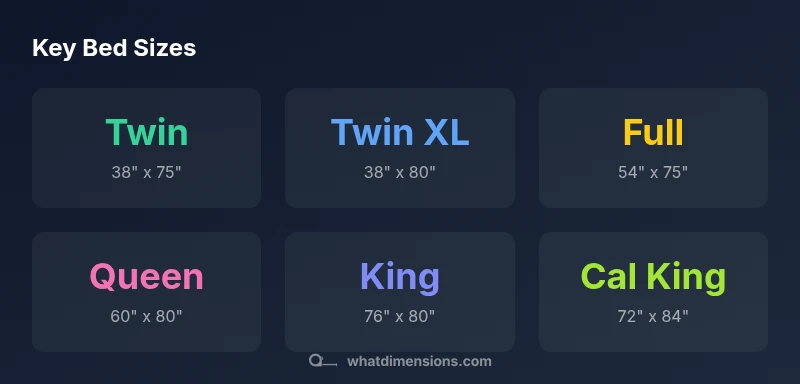
According to What Dimensions, standard size bed dimensions refer to the most common US mattress footprints: Twin (38 x 75 inches), Full (54 x 75 inches), Queen (60 x 80 inches), King (76 x 80 inches), and California King (72 x 84 inches). While regional variations exist, these measurements form the backbone of furniture planning and bedding compatibility in many homes. What Dimensions analysis shows these sizes cover a wide range of bedroom shapes and functions, enabling dependable room layouts and coordinated accessories.
What standard size bed dimensions mean for room planning
The term standard size bed dimensions refers to a core set of mattress footprints that most furniture, linens, and room layouts assume. For homeowners and designers, these measurements serve as a baseline to gauge clearance, traffic flow, and the placement of nightstands, dressers, and lamps. By starting with a reliable size framework, you can quickly visualize how a bed will fit within a given floor plan and how much space remains for movement and seating. This approach also helps prevent awkward fits when doors swing open or when windows constrain bed placement. The keyword here is consistency: a common bed footprint across rooms makes shopping for sheets, duvets, and headboards simpler and more predictable. In the US, standard size bed dimensions typically align with five primary footprints, and the What Dimensions team finds that these sizes solve most planning challenges in diverse homes.
When you’re planning, also consider room proportions, ceiling height, and rug or flooring layout. A standard bed is rarely the only factor; you must account for pathways of at least 24 inches (60 cm) around the bed for ease of movement, plus space for wardrobe doors and seating areas. If a bedroom struggles with tight access or angular walls, you may need to shift toward narrower but longer options like Twin or Twin XL, or explore innovative furniture arrangements that maximize usable floor space. Throughout, using the standard size bed dimensions as your anchor point will help you compare options quickly and make informed decisions without guesswork.
Standard US bed sizes by footprint and typical room contexts
| Size | Width (in) | Length (in) | Common Uses |
|---|---|---|---|
| Twin | 38 | 75 | Small rooms, children’s rooms, guest rooms |
| Twin XL | 38 | 80 | College rooms, taller sleepers, youth spaces |
| Full/Double | 54 | 75 | Medium rooms, guest rooms, couple spaces with storage |
| Queen | 60 | 80 | Most master and larger guest rooms, versatile fit |
| King | 76 | 80 | Spacious master suites, shared beds, premium layout |
| California King | 72 | 84 | Long-legged sleepers, rooms with generous length |
Quick Answers
What is considered a standard size bed in the US?
In the US, the standard sizes are Twin, Twin XL, Full (Double), Queen, King, and California King. Exact dimensions vary by size, but these footprints are the most widely used for planning and bedding. Always confirm the inches for your specific retailer or region.
In the US, standard beds include Twin, Twin XL, Full, Queen, King, and California King. Check the inches before you buy sheets or a headboard.
Are Queen and King bed dimensions the same across brands?
Sizes are generally standardized across major brands, but subtle variations can exist due to manufacturing tolerances and regional differences. Always verify exact measurements on the product page to ensure proper fit with sheets, frames, and nightstands.
Sizes are usually standard, but double-check the exact inches for each product.
What size bed fits in a small bedroom?
In compact rooms, a Twin or Full bed often fits best, leaving room for a dresser and nightstands. If you need more length, consider a Twin XL, but be mindful of overall width and door clearance.
Twin or Full is usually best for small rooms, keeping pathways open.
What is the difference between California King and King sizes?
A California King is longer and narrower (about 72 x 84 inches) compared with a standard King (about 76 x 80 inches). Choose based on room length and width, plus door and hallway clearance.
CK is longer but a bit narrower than a standard King.
Do bed sizes affect bedding shelf life or sheet fit?
Yes. Bedding following mattress dimensions ensures proper sheet fit and ridge-free corners. If you have a thicker mattress or adjustable base, look for deeper pockets or tailored sheets designed for that footprint.
Yes—match sheets to your mattress size, and consider depth for thicker mattresses.
Do international sizes differ from US standards?
Yes, some countries use slightly different footprints. Always check local standards or retailer specifications when shopping outside the US to avoid mismatches with sheets and frames.
International sizes can vary; verify local standards when shopping abroad.
“Accurate bed sizing starts with measuring the mattress footprint and clearance around it, then aligning with doors and furniture. In practice, standard sizes are the reliable baseline for layout, but real rooms require adjustments.”
Main Points
- Start with standard bed dimensions as your planning anchor
- Measure your room and traffic flow before choosing a size
- Twin and Twin XL fit smaller spaces; Queen and King suit larger rooms
- California King prioritizes length over width; assess hallway and door clearances
- Match bedding and furniture with the mattress footprint for best results