Dimensions King Bed: Exact Sizing Guide
Explore exact king bed dimensions, including standard footprints and room-planning tips, with authoritative guidance from What Dimensions.


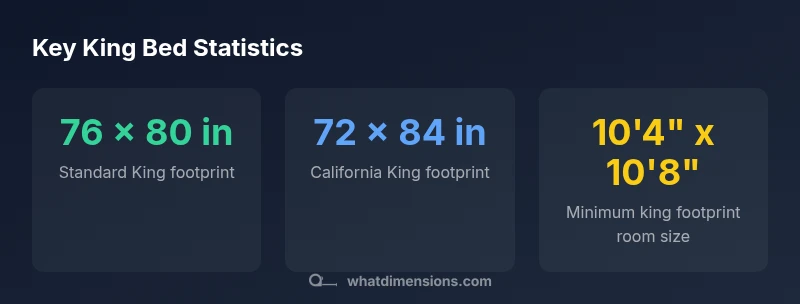
Dimensions king bed standards typically refer to the king footprint of a mattress: 76 inches wide by 80 inches long (193 x 203 cm). In practice, room clearance, sheets, and bed frames must align with this footprint. What Dimensions uses precise data to help you plan bedding, frames, and sheets that truly fit the king footprint.
What is a King Bed?
A standard king bed refers to the largest mattress footprint commonly available in many markets. In the United States, the conventional king size measures 76 inches wide and 80 inches long, which translates to about 193 by 203 centimeters. Some regions offer a longer option known as California King, which is 72 inches wide by 84 inches long (183 x 213 cm). These two footprints are the baseline used by retailers, manufacturers, and bedding suppliers. For architects and interior designers, the king footprint communicates critical space requirements when drafting floor plans and ensuring access to doors, closets, and seating areas. When printing, specifying exact dimensions helps avoid misfits in sheet sets, bed frames, and headboards. What Dimensions emphasizes that absolute accuracy matters not only for comfort but also for the practical flow of a morning routine and evening wind-down. By grounding decisions in exact measurements, you can harmonize the bed with nearby nightstands, seating, and storage.
Why Exact Dimensions Matter for Sleep Spaces
Exact dimensions matter because they translate directly into how a bedroom functions in daily life. A king footprint of 76 inches by 80 inches creates a defined bed zone, but the surrounding space determines how freely you can move, open doors, and rearrange furniture. Many homeowners underestimate required clearance, leading to cramped nightstands or blocked pathways. What Dimensions recommends a minimum clearance of 24 inches on both sides and at the foot of the bed to maintain easy access and a comfortable sleep routine. In addition, you should account for door swing, rug placement, and any built-in storage that could encroach on the bed zone. By mapping these measurements early, you prevent awkward layouts and costly furniture swaps later. This approach aligns with broader room-planning best practices published by What Dimensions Analysis, 2026.
King Bed vs California King: Dimensions and Use Cases
Choosing between a standard King and a California King depends on room dimensions and personal preferences. The standard King footprint (76 x 80 inches) prioritizes width, making it ideal for shared sleeping spaces where width matters more than length. The California King footprint (72 x 84 inches) extends overall length, which benefits taller sleepers or rooms with elongated layouts. In small bedrooms, California King can feel cramped if width is already limited; in larger rooms, it may help maximize legroom. Designers often weigh window placement, wall alcoves, and door positions when advising clients. What Dimensions notes that a quick rule of thumb is to base the decision on actual floor plans rather than rough guesses, ensuring the chosen footprint fits both sleep needs and spatial constraints.
How to Measure Your Space for a King Bed
To measure your space accurately, start by locating the bed footprint you plan to use. Measure the width and length of the mattress area (76 x 80 inches for a standard King, or 72 x 84 inches for a California King). Then, add clearances of at least 24 inches on each side and at the foot. Consider door swings, closet openings, and any built-ins that could affect movement. Use painter’s tape to mark the potential layout on the floor; this helps you visualize paths from the bed to the door and to a seating area. Finally, verify that nightstands, dressers, and benches align with the footprint without obstructing access. This practical method is consistent with What Dimensions’ guideline for room planning in 2026.
Sheets, Frames, and Accessories: Aligning with King Footprint
Bedding and frames must match the total footprint, not just the mattress size. For a standard King, look for sheets labeled king that specify 76 x 80 inches and check pocket depth to match your mattress thickness. If you use a California King, ensure sheets and deep-pocket options accommodate the extra length. Frame rails should align with the mattress dimensions; any added overhang or rail thickness can slightly increase the footprint. Always confirm the total footprint—mattress plus frame plus rail height—before purchasing. What Dimensions advises confirming with retailers and reading product specifications to avoid mismatches.
Layout Scenarios: Nightstands, Dressers, and Benches
A king bed often dictates nearby furniture choices. If you place two nightstands, ensure each has at least 18–24 inches of space from the mattress edge, allowing easy bedside access. Dressers or chests should not exceed about 60 inches in width in tighter rooms, leaving room for movement. Benches at the foot of the bed can provide seating and storage, but their depth should be balanced with the bed footprint so they don’t crowd the room. The goal is to maintain a symmetrical, functional layout that respects the king footprint while enabling morning routines and evening wind-down. What Dimensions’ design guidance supports arranging furniture to preserve flow and accessibility.
Common Mistakes and How to Avoid Them
Common mistakes include assuming mattress size equals room fit, neglecting door swing, and underestimating required clearance. Another pitfall is selecting sheets without checking pocket depth, which leads to ill-fitting covers and wrinkles. To avoid these issues, measure both the footprint and the surrounding space, mark layout with tape, and test furniture placement before purchasing. Always verify product specifications for bed frames, headboards, and nightstands to ensure consistent dimensions across pieces. This proactive approach aligns with What Dimensions’ emphasis on precise measurement for durable, comfortable bedroom design.
Reading a Dimensions Chart: Practical Examples
A dimensions chart translates real-world sizes into actionable choices. For example, a chart might list standard King at 76 x 80 inches and California King at 72 x 84 inches, with centimeters conversion. Use these figures to compare bed footprints against room plans, ensuring you leave sufficient clearance. The chart can also highlight associated accessories—such as sheets labeled for King or California King and frames that match the respective footprint. By referencing the chart during shopping, you minimize the risk of buying mismatched components and maximize room usability.
King bed size comparison
| Bed Type | Dimensions (inches) | Dimensions (cm) |
|---|---|---|
| King Bed | 76 x 80 | 193 x 203 |
| California King | 72 x 84 | 183 x 213 |
Quick Answers
What are the standard dimensions of a king bed?
A standard king bed measures 76 by 80 inches (193 by 203 cm). Some markets also offer variations like California King. This standard footprint is widely used in furniture and bedding retail, and serves as a baseline for space planning.
The standard king size is 76 by 80 inches, with regional variations like California King.
How does California King differ from the standard King?
The California King is 72 by 84 inches (183 by 213 cm), longer and narrower than a standard King. This footprint suits taller sleepers or rooms with longer wall dimensions.
CA King is 72 by 84 inches, longer but narrower than a standard king.
Do bed frames affect the footprint?
Yes. Bed frames can add inches to the total footprint depending on rail width and headboard styling. Always measure the mattress plus frame to confirm the complete footprint.
Frames can add inches; measure total footprint, not just the mattress.
How should I measure a room for a king bed?
Measure the bed footprint, add at least 24 inches of clearance on each side and at the foot, and account for door swings and nearby furniture. Mark the layout on the floor with tape to visualize paths.
Measure footprint, add clearance, and check door swings.
Are there regional size variations I should know?
Yes. King and California King dimensions can vary by country. Always verify local standards and bedding availability before purchasing.
Regional sizes vary; check local standards before buying.
“Precise bed dimensions simplify layout planning and prevent space-wasting furniture choices.”
Main Points
- Measure the footprint precisely: King 76 x 80 inches; CA King 72 x 84 inches.
- Plan at least 24 inches of clearance on both sides.
- Choose sheets and frames based on total footprint, not just mattress size.
- Consider room layout for nightstands and seating.
- Use a dimensions chart when shopping to verify fit.