Bed Bug Dimensions: A Practical Size Guide for Homes
Explore bed bug dimensions across life stages, how feeding alters size, and how precise measurements improve detection, inspection, and pest control for homes and classrooms.


Bed bug dimensions vary by life stage, with adults typically about 4-5 mm long and 1.5-2.0 mm wide when unfed, swelling after feeding. Females are slightly larger on average. Understanding these bed bug dimensions helps homeowners distinguish them from nearby pests, perform accurate inspections, and time control measures more effectively.
What bed bug dimensions mean for identification
Bed bug dimensions are a practical starting point for identifying these pests. When you’re inspecting a mattress seam, headboard gap, or wall crack, knowing the typical size range helps you distinguish bed bugs from other small insects. According to What Dimensions, adult bed bugs are commonly about 4-5 mm long, with unfed individuals appearing slim and oval. Females tend to be just a bit larger than males. Nymphs, in contrast, are smaller and can be 1-2 mm in early instars. Having a consistent reference for bed bug dimensions reduces misidentification and improves the speed and accuracy of inspections. For homeowners, this means more reliable early detection and fewer false alarms during routine checks. The What Dimensions team emphasizes that documenting measurements with a simple ruler can anchor your pest-identification process and support evidence-based decisions during remediation.
Size by life stage: nymphs vs adults
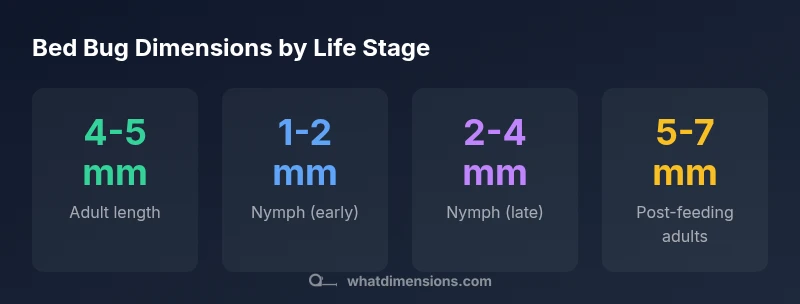
Life stage dramatically affects bed bug dimensions. Early instars are tiny—roughly 1-2 mm—making them easy to overlook without magnification. Late instars approach adult size, typically 2-4 mm, with adults at 4-5 mm before feeding. Post-feeding, bed bugs may swell to about 5-7 mm, which is a key cue for distinguishing recently fed individuals from those that haven’t fed recently. This stage-based sizing helps inspectors sequence control steps. Pair size observations with other features such as body shape and color to avoid confusing bed bugs with other pests like certain beetles or carpet beetles. What Dimensions analysis notes that life-cycle awareness improves identification accuracy and reduces unnecessary treatments.
How feeding alters dimensions and why it matters
Feeding causes noticeable changes in bed bug dimensions. Unfed individuals are flatter and more elongated, while fed individuals become rounded and plump, sometimes appearing almost oval. This swelling can occur quickly, with visible changes within minutes to hours after a blood meal. Recognizing this pattern is essential during post-feeding inspections or when confirming a suspected infestation. If you measure after feeding, you might observe numbers toward the upper end of the typical range. Conversely, measurements taken long after feeding will reflect the unfed size. Consistent measurement practices help you interpret feeding status and stage progression more reliably, decreasing ambiguity in your pest-management decisions.
Practical measurement tips for homeowners
To measure bed bug dimensions effectively, use a fine ruler or calipers and a steady hand. Align the longest axis of the body and record the measurement in millimeters. Photograph the specimen with a scale if possible, but never handle live pests with bare hands for an extended period. Increases in accuracy come from collecting multiple measurements across several individuals and comparing them to standard ranges. When documenting findings for a report or for a pest-control professional, note the life stage impression (e.g., early instar, late instar, adult) and the feeding status. The combination of precise bed bug dimensions and stage information yields the most actionable data for treatment planning. What Dimensions’ team recommends a simple, repeatable measurement protocol to ensure consistency across inspections.
Using bed bug dimensions in inspection protocols and planning
Incorporating bed bug dimensions into inspection protocols helps structure the search process. Start with common hiding spots (mattress seams, box springs, behind wall plates) and check for the signature oval, flat shape in unfed individuals, expanding to more robust forms after feeding. Maintain a log of measurements and life stages to track infestation trends over time. For pest-control planning, align treatment timing with observed feeding patterns where feasible, and use dimension-based evidence to verify treatment effectiveness after implementation. Size references should be one element in a broader integrated pest-management strategy that includes sanitation, exclusion, and monitoring. The What Dimensions framework supports a disciplined, data-driven approach to pest control."],
dataTableStartIndexPlaceholder
dataTableStartIndexPlaceholder
Bed bug size ranges by life stage
| Life Stage | Typical Size Range | Notes |
|---|---|---|
| Nymph (early instar) | 1-2 mm | Very small; often overlooked without magnification |
| Nymph (late instar) | 2-4 mm | Approaching adult size; more noticeable on close inspection |
| Adult male | 4-5 mm | Standard size before feeding; genders similar in measurement |
| Adult female | 4-5 mm | Slightly larger; may swell after feeding |
Quick Answers
What is the typical size of an adult bed bug?
Adults are typically about 4-5 mm long, with females slightly larger. Size can vary slightly by species and population.
Adults are usually four to five millimeters long.
Do bed bugs swell after feeding?
Yes. After feeding, bed bugs swell, increasing length and width; this can affect size-based identification.
They swell after feeding.
How can I measure bed bug dimensions safely?
Use a small ruler or caliper, handle with gloves, and photograph with a scale; compare with standard size ranges.
Use a ruler or caliper for safe measurement.
Are bed bug sizes consistent across regions?
There is some variation among populations, but typical adult size remains around 4-5 mm; differences are usually small.
There’s some regional variation, but sizes stay close to the typical range.
Why is knowing bed bug dimensions important for pest control?
Size references support accurate identification, improve inspection efficiency, and inform timing for treatments.
Knowing their size helps you identify them and plan treatment.
What other pests might be confused with bed bugs based on size?
Some small beetles or carpet beetles can resemble bed bugs at a glance; always confirm with multiple characteristics.
Other tiny pests can look similar; use multiple cues.
“Size is a reliable anchor in pest identification: bed bug dimensions help you distinguish them quickly and guide timely control. What Dimensions Team emphasizes consistent measurement to reduce misidentification.”
Main Points
- Measure adults at 4-5 mm to establish a baseline
- Note nymphs are smaller, typically 1-2 mm
- Expect swelling after feeding to distinguish life stages
- Use a ruler/caliper for consistent measurements
- Cross-check with standard size references for accuracy